

The Packet Loaf Has No Added Sugar, and More Sugar Than Sourdough
We said the packet loaf burns faster because it is sweetened. It has no added sugar, and still more sugar than sourdough. Here is the correction.
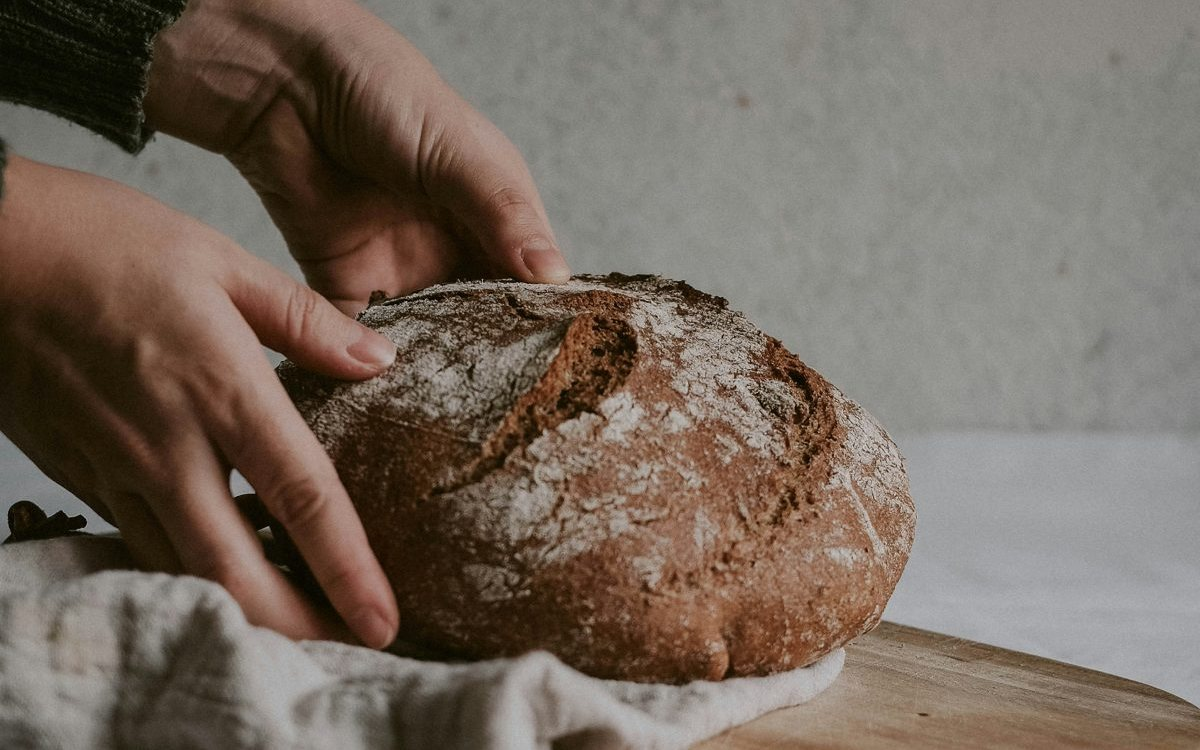
In August we published a post here arguing that a supermarket sandwich slice burns in the toaster before a baker's loaf browns, and that the reason was added sugar in the packet loaf. The added sugar part is wrong. The labels say so, the manufacturer says so on its own website, and the food regulator's own analysis says so. So this is the post rewritten rather than quietly patched.
There is still a sugar story in a slice of packet bread. It is just not the one we told.
What the packet actually lists
Tip Top answers this on its own site. Under the question "Is sugar added to our bread?" the FAQ reads: "No sugar or syrup is added to our Tip Top regular sliced bread. Any sugars listed on the Nutrition Information Panel come naturally from the baking process and small amounts left after fermentation, which must be shown by law." Checked 25 September 2026.
The labels hold that up. Sunblest White Sandwich lists unbleached wheat flour, water, baker's yeast, vinegar, iodised salt, canola oil, soy flour, emulsifiers, added thiamin and folic acid, wheat gluten, and a processing aid. No sugar anywhere in it. Its panel reads 2.1 grams of sugars per 100 grams. The One White Sandwich lists the same things and reads 2.0 grams. The 9 Grain loaf, which the site now calls Classic, reads 2.2 grams. All three checked 25 September 2026.
A panel counts the sugars that are in the food, added or not. FSANZ puts it plainly on its sugar labelling page: "Total sugars includes sugar that is naturally present in the food and sugar that has been added as an ingredient."
The other direction matters too, because "supermarket bread is sugar-free" would be just as wrong. Gluten-free loaves list sugar outright, at 3.8 and 5.2 grams per 100 grams on the two we checked. Fruit loaves, brioche and buns run higher again. What we could not find, on any plain white or wholemeal sandwich loaf across the ranges we checked, was sugar in the ingredient list.
What actually makes toast brown
Toast colour comes from two reactions. Maillard, where reducing sugars meet amino acids and heat, and caramelisation, where sugars break down under heat on their own. Both wait for the same thing. The face of the slice has to get dry and hot first.
Emmanuel Purlis, reviewing browning in baked goods for the Journal of Food Engineering in 2010, gives the bread threshold as a surface temperature above 120 degrees and water activity below 0.6, and gives the reason with it: making coloured compounds "always needs at least one dehydration step", so "too much water induces an inhibition of browning". A toaster spends its first seconds drying, not colouring.
What sets the pace after that, from the same review: "sugars content and the type of sugar are the main variables affecting colour formation."
The packet loaf does carry more sugar, and not added sugar. FSANZ's Australian Food Composition Database, Release 3, records bread from white flour at 3.1 grams of sugars per 100 grams and commercial white sourdough at 1.2 grams. Added sugars in both entries: zero. Those are analysed composites of real loaves bought across five states. Read from the published FSANZ workbook, 25 September 2026.
Which looks like it settles the question, and it does not, because the other lever runs the other way. Sourdough is acidic, and acid slows the browning reaction down. A 2025 review in Foods puts it plainly: below about pH 6 the reaction is very slow, and fewer of the brown pigments form. Yeast bread sits around pH 5.3 to 5.8. Sourdough bread sits around 3.8 to 4.9.
When someone actually measured the crusts, acid won. A 2024 study in Foods baked sourdough loaves against yeast controls and scored the crust: every sourdough came out significantly less browned than both controls. A 2022 study in Food Chemistry found the brown-pigment pathway dominant in the yeast crust and the aroma pathway dominant in the sourdough one. Both measured oven crust, not toast.
Where the evidence runs out
Nobody appears to have put a packet slice and a bakery slice into the same toaster and published what happened. We went looking and did not find it. There is work on toasting one bread for longer, which finds colour climbing steadily with time, and that answers a different question.
A 2026 toasting study in European Food Research and Technology lists comparing bread types as work still to be done, which is about as close to an official not-yet-studied as this literature gets. It toasted one loaf.
So the sugar gap is a direction, not a rate. FSANZ measures total sugars, and the browning reaction runs on reducing sugars, which is a narrower thing. Three grams against one is a real difference in the bread. Whether it shows at the same number on your toaster dial, against an acidity difference pulling the other way, is not something anyone has measured.
Which means the tidy version of this post, the one we published in August, was always going to be wrong. Not just in its reason. In being certain at all.
Two other lines from the August post do not survive a check either. We wrote that a dense fresh loaf holds more water and the packet loaf is comparatively dry. The composition table says the reverse, or near enough to nothing: white sliced bread at 38.2 grams of water per 100 grams, commercial white sourdough at 38.8, crusty Italian-style at 35.3. The packet loaf is not the dry one, so that bullet is gone.
And the old heading set a four-ingredient loaf against a fifteen-ingredient loaf, which only works if each emulsifier and each added vitamin gets counted as a line of its own. Bakers Delight's plain White Block Loaf lists seven things. Sunblest lists eleven. The list is worth reading. It is not worth counting.
What a label is allowed to leave out
Reading the packet does not tell you everything that was used to make the bread. That is how the rules are written, not somebody hiding something.
The Australia New Zealand Food Standards Code, at Standard 1.2.4, says a statement of ingredients "need not list ... a substance that is used as a processing aid" or "a food that is used as a processing aid". Alpha-amylase, the enzyme that cuts starch into sugar, sits on the Code's permitted-enzymes list, and several permitted enzymes carry a condition of use naming the manufacture of bakery products. Ascorbic acid is on the list of additives permitted at good manufacturing practice. None of that has to appear in the list on the bag. What appears instead is that short line at the end of nearly every sliced-bread list in the country: processing aid (wheat). Read from the April 2026 compilation of the Code, 25 September 2026.
So nothing on a label rules an enzyme in or out, and we are not claiming either way about any particular loaf.
Malt is a smaller surprise in the same direction. It does turn up on Australian bread labels, just not where the old post put it. Helga's Light Rye lists malted barley flour. The plain white sliced loaves we checked list none. "Malt is what the packet has and the baker does not" was the wrong way round, so it is out.
The thing a label cannot do at all is answer a question. That part only works when there is somebody to ask.
Six bakers, checked today
All six were live on SideStall when we checked, 25 September 2026, and all six are in South Australia. Each name links to their stall page, which shows what they have listed. Prices and hours are in the app, and directions once the seller shows their address. Small batches sell out, so pre-order where you can.
- Murray Dough, Adelaide · classic sourdough, and a jalapeno and cheese one.
- The Bread Basket Roseworthy, Roseworthy · sourdough original, and a sourdough with olive and feta. Both listed for Friday pickup, orders in by midday Wednesday.
- Nonna's Forno, Salisbury Heights · pizza bases, and pane and panini.
- Baked at home, Two Wells · white bread, cookies, and fresh eggs.
Two more worth knowing about, though neither has bread on their page today:
- Farm stand bakery, Aldinga · brookie, cornflake brownie, apricot slice and carrot cake.
- Mumma Bakes SA, Elizabeth North · chunky cookies, with gluten free and vegan gluten free versions.
Getting one this week
- Open the map. Stalls near you by distance, with whether each one is open.
- Search what you want, not who makes it. Try sourdough, bread or rolls. Search matches the products sellers have listed. A stall's name finds nothing, so use the product, or the @handle if you know it.
- Look at the stall page before you drive.
- Pre-order the bread. That is the one that sells out.
One thing holds whichever loaf ends up in the toaster. FSANZ's advice on acrylamide is to "toast bread or other foods to the lightest colour acceptable to your taste, noting that the crust will have higher levels of acrylamide". Its acrylamide page was last updated 3 August 2026.
If you want the label-reading version of all this, we wrote about what the word sourdough does and does not mean in Australia.
Download the SideStall app, free on iPhone and Android, and see who is baking near you.
Sources, all checked 25 September 2026. Labels and panels: Tip Top FAQs, Sunblest White Sandwich, The One White Sandwich, 9 Grain Classic, The One Gluten Free Soft White, The One Gluten Free Smooth Wholegrain, Helga's Light Rye, and Bakers Delight White Block Loaf, each read from the manufacturer's own product page. Composition: FSANZ Australian Food Composition Database Release 3, entries for bread from white flour, commercial white sourdough, rye sourdough, Italian-style and wholemeal, read from the published workbook. Labelling and additives: FSANZ sugar labelling page, FSANZ acrylamide page, and the Australia New Zealand Food Standards Code, April 2026 compilation, Standard 1.2.4 and Schedules 16 and 18. Browning: Emmanuel Purlis, 'Browning development in bakery products, a review', Journal of Food Engineering 99 (2010) 239 to 249, and Ramirez-Jimenez et al., 'Effect of toasting time on the browning of sliced bread', Journal of the Science of Food and Agriculture, 2001. Acidity and sourdough crust colour: El Hosry et al., 'Maillard Reaction: Mechanism, Influencing Parameters, Advantages, Disadvantages, and Food Industrial Applications', Foods 14 (2025) 1881; Sahin et al., 'Harnessing the Role of Three Lactic Acid Bacteria Strains for Type II Sourdough Production', Foods 13 (2024) 1801, crust browning index by bread; Troadec et al., 'Effect of leavening agent on Maillard reaction and the bifidogenic effect of traditional French bread', Food Chemistry 393 (2022) 133387. Bread types not yet compared in a toaster: Sepehr et al., European Food Research and Technology 252 (2026) 73.