

I Almost Shared That Food Secrets Reel. Then We Checked It
A reel doing the rounds says your chicken is bleached and your apples are waxed with petroleum. We checked every claim. Some hold up. Most don't.
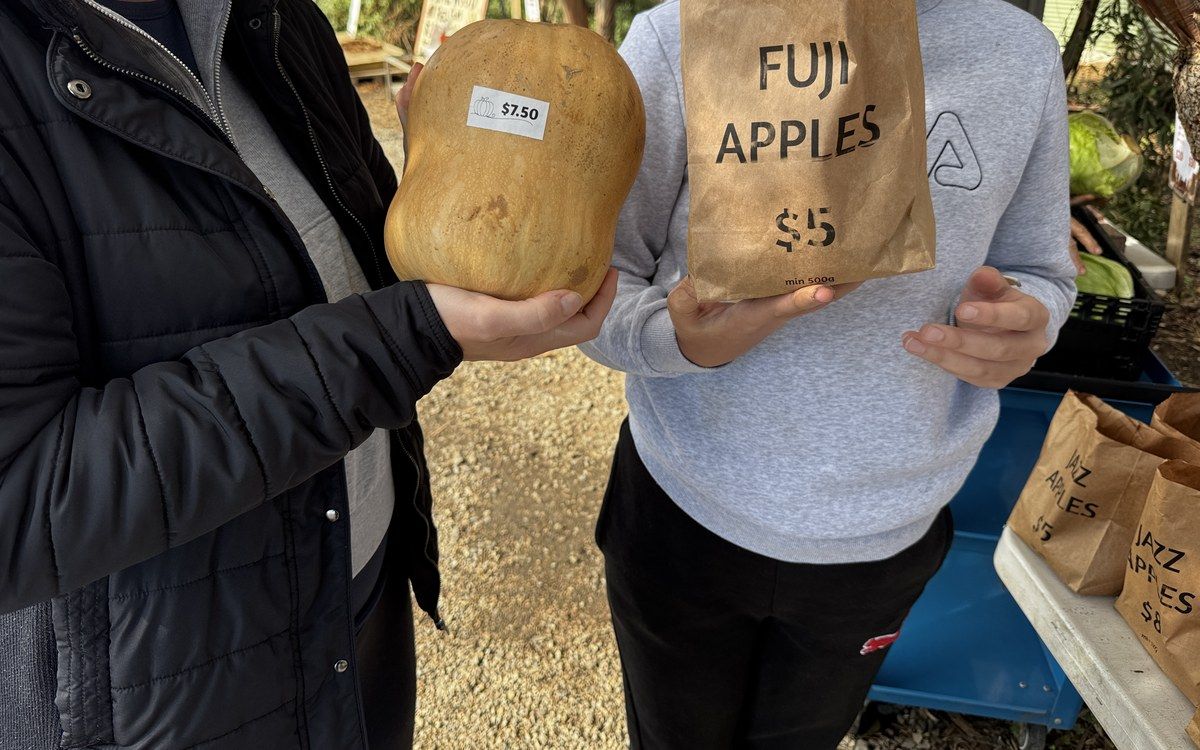
Last month a reel came through my feed with a list of food industry secrets. Chicken dipped in chlorine. Chicken breast injected with phosphates. Apples coated in petroleum wax. Potatoes sprayed with a chemical banned in Europe. Olive oil that's mostly fraud. It had thousands of shares, and one slide even said smaller local farmers don't do any of this, which is pretty much my whole pitch.
So you'd think I'd just share it and take the free marketing. I nearly did. But SideStall only works if people can trust what producers tell them, and that has to start with me not passing on rubbish. So before it went any further, we ran every claim down against the actual sources. Australian sources where they exist, because a lot of these reels are American claims with an Aussie accent.
This is what held up and what didn't.
“Your chicken is dipped in chlorine”
Partly true, heavily overcooked. Most Australian chicken really is chilled in chlorinated water after processing. The industry body says so itself. But the strength matters, and what the industry body describes is a food-contact sanitiser in the chiller water, not a bleach bath.
The reel leans on the EU ban, and the EU really does require plain water instead. But the EU's own food safety authority found that treating chicken with these substances raised no safety concern, though it noted it hadn't assessed the chlorine by-products themselves. Their rule is about how food should be processed, not a finding that the chicken is dangerous. And the “small farmers won't do this” line doesn't hold as a blanket rule either. Even a small brand gets the same chlorinated chill water if its birds go through a plant that immersion chills. Not every brand does. Inglewood Organic says its organic chickens are never submerged in a chlorinated ice bath and are air chilled instead, though the water used earlier in its processing still carries low levels of chlorine.
“Your chicken breast is injected with water and phosphate”
False for the raw breast fillets you actually buy. The plain fillets at the big supermarkets have an ingredient list that's one item long: chicken. Australian labelling law requires added water and phosphates to be declared, so an injected fillet can't legally be sold as just “chicken breast”.
Where it is true: once chicken gets roasted, marinated, crumbed or pre-cooked, water, salt and mineral salts (those 450, 451 and 452 numbers) turn up all the time. One big-supermarket hot roast chook lists 84 per cent chicken, and the rest is marinade, stuffing and seasoning, with eight more ingredients in the marinade beyond those three. The label tells you which one you're holding, and reading it takes ten seconds.
“Apples are the most chemically treated fruit, coated in petroleum wax”
One true thing wrapped in made-up numbers. The true bit: Australian apples can legally be treated after harvest with a fungicide called thiabendazole, and studies show some of it gets into the peel where washing won't remove it. That's real and worth knowing.
The rest doesn't check out. The “over 1500 chemicals” figure has no traceable source anywhere. The petroleum wax claim is flat wrong for Australia: our apples get shellac or carnauba if they're waxed at all, both food-grade coatings, and according to Apple and Pear Australia the big chains stopped waxing apples altogether back in 2017. And “most chemically treated fruit in the supermarket” isn't supported even by the American list it's borrowed from, where apples sit eighth on the 2026 list.
“Every non-organic potato is sprayed with a banned chemical”
The closest to true, still overstated. The chemical is chlorpropham, a sprout suppressant, and the EU really did pull it in 2019. It's still legal here in Australia, and that gap between their rules and ours is a fair thing to ask questions about.
But two corrections. It's a storage treatment, fogged onto potatoes going into long storage, so “every non-organic potato” is wrong. Fresh new-season spuds, and most of what you'd buy at a farm gate, never see it. And the cancer line is wrong too. Europe dropped the chemical in 2019 over unresolved data gaps and consumer exposure concerns. Serious enough to act on, but not the cancer finding the reel claims.
“85 per cent of extra virgin olive oil tested in Australia failed the standard”
A real number, ten years old, missing its biggest caveat. That test was run by the Australian Olive Association in 2016, on 27 imported oils. 85 per cent failed the voluntary Australian standard. Half of the 27 oils failed on taste, for being rancid, musty or stale, and the rest of the failures were on other quality and composition grounds rather than for being proven fake. Australian-grown extra virgin olive oil wasn't the problem then and performs well now. If anything the finding is a reason to buy local oil, which is not how the reel plays it.
Olive oil fraud in general is very real. It topped a European Parliament list of foods most at risk of fraud in 2013, and European police have seized truckloads of seed oil dyed green with chlorophyll. Those cases were in Italy and Spain though. There's no evidence that's common on Australian shelves today.
The berry story on top: “500 times more pesticide residue”
The reel was shared under a news caption about regulators allowing up to 500 times more pesticide residue. That number is real. In June 2026 the APVMA proposed raising the residue limits for an insecticide called isocycloseram on berries, lifting the limit on raspberries from 0.01 milligrams per kilo to 5. Pesticide Action Australia says the chemical counts as a forever chemical under European definitions, though not every regulator agrees it does, and the proposal has drawn serious criticism.
The context the caption leaves out: the 0.01 was already on the books. Isocycloseram had been allowed on berries under a permit issued in April 2024, and the berry limits that the September change replaced were temporary ones pegged to the lowest level a lab can reliably measure, because residues from that use were not expected above it. Measured from a starting line that close to zero, the new limit reads as a giant multiple. The regulator says treated berries are safe to eat and critics dispute that. The APVMA has since made the change. The new limits, including 5 milligrams per kilo on raspberries, were gazetted on 22 September 2026 and apply from that day.
So where does that leave you
The scorecard: two claims mostly hold up once you trim the exaggeration, two are half true, and two fall apart the moment you look. Which is about par for these reels. The scary version gets the shares, and the correction never catches up.
What I keep coming back to is that the fix is the same whether the claims are true or not. You can't audit a supply chain from the label side of the shelf. We said the same thing after the Four Corners food fraud story: a label is a claim, and the real question is how many strangers stand between you and your food.
Buying direct doesn't make chemistry disappear. Nobody at a farm gate can promise you a world with no fungicide in it. What it gives you is a person you can ask. Whether the spuds sat in storage, when the oil was pressed, what the chooks are getting fed. Ask a supermarket shelf those questions and see how far you get. Ask a grower at their gate and you'll usually get more detail than you bargained for, because the details are the reason they do it the hard way.
Find someone you can actually ask
New here? SideStall is a free app that maps the farm gates, roadside stalls and honesty boxes near you. Get it for iPhone or Android.
- Open the map. Stalls near you by distance, sellers who are open now up front.
- Search the product. Type “potatoes”, “olive oil” or “eggs” and search matches what sellers have actually listed, with photos and prices.
- Read the stall page before you drive. Photos and what is on the table, with hours in the app, and directions once the seller shows their address.
- Ask your questions at the gate. The good ones love being asked.
- Favourite the stalls you trust so you're not starting from scratch next week.
For anyone who wants to check it for themselves, the sources are the Australian Chicken Meat Federation, Inglewood Organic's own FAQ, the Food Standards Code, the European Food Safety Authority, Apple and Pear Australia, the APVMA's June and September 2026 gazettes, the Australian Olive Association's 2016 testing and the ABC's reporting on the berry proposal. We haven't linked them because we keep links to our own pages, but every one is findable by name.
Download the SideStall app, free on iPhone and Android, and see who's growing, baking and keeping chooks near you.
Grow it, bake it or raise it yourself? List your stall on SideStall. It's free to start, there's no monthly fee to take payments on any plan including Free, and a small SideStall platform fee plus card processing applies only when a buyer actually pays in the app. Set up your stall →