
When the Label Can't Be Trusted, Ask the Person Who Made It
Four Corners found food fraud is rampant in Australian supermarkets. It gets in at the handovers between farm and shelf, and buying direct has only one.
On 27 July, ABC's Four Corners aired the first part of an eight-month investigation into food fraud in Australia. Reporter Adele Ferguson had everyday supermarket products forensically tested, the kind of pantry items that go in the trolley without a second thought, and then followed the supply chains behind them.
The ABC's own summary of what they found puts it about as plainly as it can be put: food fraud is "easy to commit, hard to detect, and worth billions."
The specifics are worth watching for yourself. But the shape of it is this: products carrying Australian origin claims that testing said were grown somewhere else. Spices bulked out with cheaper material that isn't the spice. Seafood that wasn't from where the packet said. Eggs sold under farming claims the farms didn't match. Allergens that weren't declared, and nearly half of those recalls were first picked up by a customer, not the company or the regulator.
None of this is about one bad company. It's about what happens to food between a farm and a shelf.
Fraud lives in the gaps
Think about how far a jar of pasta sauce travels before you pick it up. Someone grows the tomatoes. Someone else harvests them. They're sold to a processor, possibly through a broker, possibly through several. They're concentrated into paste, shipped, blended with paste from other sources, packed, branded, distributed, shelved.
Every one of those handovers is a point where something can be swapped, diluted, blended or relabelled, and where the person doing it is invisible to you, and often to the company whose name ends up on the jar.
That's why food fraud is so hard to police. By the time a product reaches a shelf, the evidence of what happened to it early on has usually been processed out of existence. It takes a laboratory to find it again, which is precisely what the Four Corners team had to do.
And the label can't help you here, because a label is a claim, not a proof. It's written by the company selling the product. Some claims are legally defined and enforceable: under Australia's country-of-origin rules, a priority food can only say it was grown in Australia if every ingredient was. Plenty of others aren't defined at all. "Natural" has no legal definition in the food standards code. Neither does "sourdough", as it happens. A phrase on the front of a packet can be entirely meaningless and entirely legal at the same time.
So the question isn't really "how do I read labels better?" You can get very good at reading labels and still be duped, because you're auditing the wrong thing. The question is how many strangers stood between you and your food.
The short-chain alternative
We want to be careful here: buying direct from a producer is not a guarantee. Nobody at SideStall tests anyone's tomatoes. We don't certify origin, and we'd be doing exactly what this investigation is about if we claimed we did.
What changes is the number of gaps.
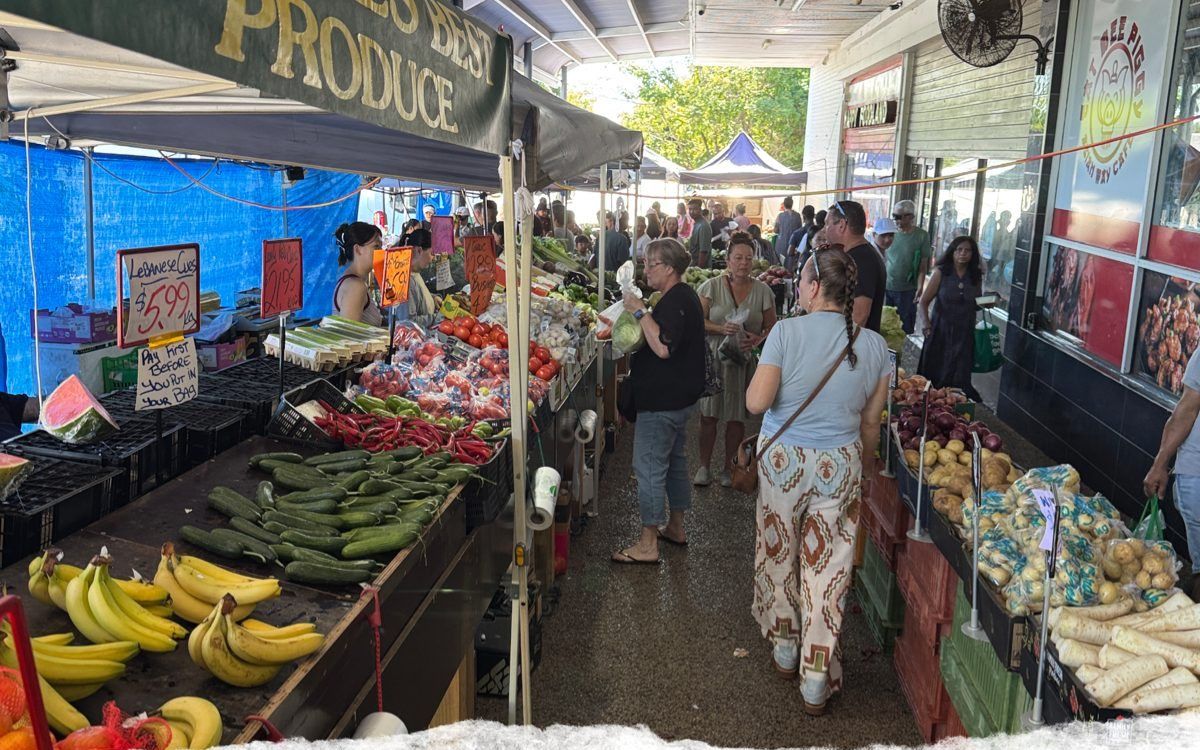
When you buy a loaf from the person who baked it, or eggs from the person who keeps the chickens, there is one step between the food and you. There's no broker, no blending, no relabelling, no chance for something to be substituted in a warehouse you'll never see. The chain is short enough to hold in your head.
And the person at the other end of it isn't a brand. They're someone standing at a gate you can drive to, who has to look at you again next week. That accountability does more work than any wording on a packet:
- You can ask, and get a straight answer. What's in it, where it was grown, what was flowering, how long it fermented. Producers selling direct are usually delighted to be asked: the details are the reason they do it the hard way.
- You can see the place. A stall on a farm is difficult to misrepresent while you're standing in front of it.
- What's not there tells you something. Food that hasn't been shipped, stored and stabilised for a long shelf life doesn't need the additives that make that possible.
- Nobody in the middle is under pressure to cut a margin. Most fraud is a cost decision made several steps removed from the person whose name is on the label.
You'll still want to use your judgement. But it's judgement about a person you've met, not a supply chain you can't see.
Finding bakers and producers near you
The hard part has never been that these people don't exist. It's that they're scattered down side roads with a hand-painted sign, and you drive past at 80 and never know. That's the problem SideStall was built for.
- Open the map. SideStall shows the stalls near you by distance, with sellers who are open now up front: farm gates, roadside stalls, honesty boxes, home bakers.
- Search the product, not the person. Type "sourdough", "eggs" or "tomatoes" and search matches what sellers have actually listed, with photos and prices. Browsing a category like Baked Goods or Eggs, Dairy & Honey works the same way.
- Read the stall page before you drive. Each seller has a public page with photos and what is on the table, and the app has their hours and payment methods. Directions appear once the seller shows their address. This is where you find out who you're buying from.
- Pre-order when it's small-batch. Bakers and small producers sell out; that's what doing it properly looks like. Reserve in the app, and once the seller accepts your request it's set aside for you.
- Pay however suits. Card, Apple Pay or Google Pay in the app, or cash at the gate if the seller takes it. Every stall in the app shows what it accepts.
- Favourite the good ones. The point is to stop starting from scratch. Once you've found a baker you trust, they're one tap away.
No one near you yet? SideStall grows gate by gate, so it's worth another look in a week, and if you know someone local who bakes, grows or keeps chooks, send them our way.
The short version
A major investigation just demonstrated that you cannot verify your food by reading the packet, because the packet is a claim made by someone with an interest in the claim, at the end of a chain you can't see.
You're not going to fix that by shopping harder. But you can shorten the chain. Buy the things you can buy direct (bread, eggs, vegetables, fruit, preserves) from the person who made them, and ask them about it. It won't cover your whole trolley. It doesn't have to.
Then download the SideStall app, free on iPhone and Android, and see who's growing, baking and keeping bees near you.
Grow it, bake it or raise it yourself? List your stall on SideStall. It's free to start, there's no monthly fee to take payments on any plan including Free. When a buyer actually pays in the app, a small SideStall platform fee plus card processing comes out. Set up your stall →