

10. Bulk Deals and Product Variants: Selling More Per Visit
One customer who buys a tray instead of a dozen is worth more than a new customer, and costs nothing to find. Two listing features that make it easy.

There are two ways to make more from a stall. Find more customers, or sell more to the ones already standing in front of you.
The second is much cheaper. On plans: volume deals come with the Standard plan, and product variants are part of the Commercial plan, alongside the web seller workspace.
Product variants
Variants let one listing carry several options: size, cut or pack.
The shape of it: an option type with its values (say, size: Small and Large), and a second option type you can add in the seller portal. Each variant carries its own price, its own stock, its own availability toggle and, if you use them, an SKU. Your base price and stock do not disappear. Buyers still see them as the flat, at-a-glance version of the product, so keep them representative of what you actually charge.
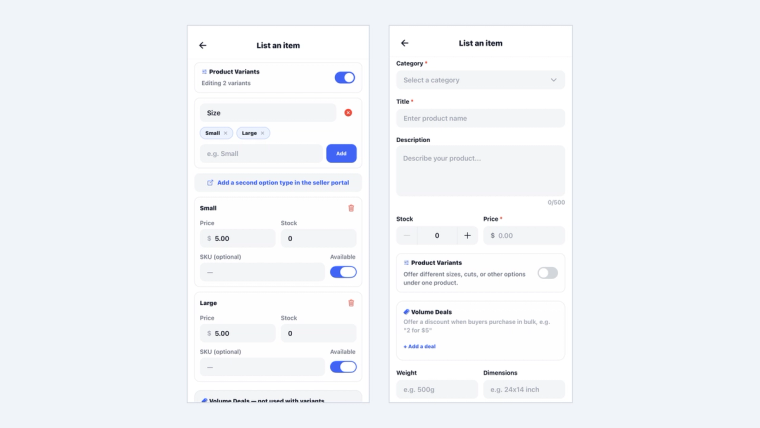
The tidiness is the obvious benefit: a half loaf and a whole loaf are one listing rather than two competing ones, and your stall page stops looking like a spreadsheet.
The less obvious benefit is what it does to the buyer's thinking. Someone looking at a single $8 loaf is deciding whether to buy. Someone looking at a $5 half and an $8 whole is deciding which, and a surprising number of people, having framed it that way, take the bigger one.
Good candidates: half and whole anything, small and large bunches, single and mixed packs, different cuts of the same animal.
Volume and bulk-buy deals
Bulk deals let you price a larger quantity more attractively than the same number of singles. A product takes variants or a volume deal, not both. Once variants are switched on for a product, the List an item form marks its Volume Deals card as not used with variants, so pick whichever fits that product.
The one thing to get right, and the classic mistake, is that a deal is the total price for that quantity, not the price each: “3 for $20” means the buyer pays $20 for the three.
This suits farm-gate selling particularly well, because a great deal of what gets sold at a gate is genuinely better bought in quantity. A tray of eggs. A box of seconds for preserving. Two kilos of tomatoes when the glut is on and the alternative is compost.
Three things worth knowing:
- Make the saving real. A token discount insults people. If a dozen is $8, a tray should feel like a genuinely better idea.
- Use it to clear gluts, not your best stock. Bulk is how you sell the fifteen kilos you cannot possibly sell in ones.
- Say what it is for. "Great for preserving" or "feeds a crowd" does more work than the price alone.
What this changes
Your costs at a gate barely move between a small sale and a large one. The same drive, the same setup, the same conversation. So the difference between a customer buying a dozen and the same customer buying a tray is almost pure gain.
That is the whole argument for these two. Not more people: more from the people who already came.
That's the series
Ten posts, from claiming your handle to selling a tray instead of a dozen. If you have worked through them, you have a stall that is findable, obviously open when it is open, paid before pickup, honest about where it is, trusted by strangers, and worth coming back to.
The rest is produce, which was always the part you were good at.
Anything unclear, or something you want covered? Tell us. We would rather write the post you actually need.
You can start on the Free plan, and there is no monthly fee to take payments on any plan. Set up your stall and put it to work.